

A practical guide for corporate travel buyers who prioritise value and traveller experience
In a typical corporate travel program, the majority of accommodation bookings are short trips – the quick one-to-three-night stays for meetings, training sessions, conferences, or client visits. Because short stays have historically dominated corporate travel volume, RFPs have long been structured around hotels’ needs and characteristics. So there has been no need for a hotel vs serviced apartment cost comparison.
But corporate travel patterns have shifted.
Longer assignments, relocation programs, multi-week or year-long projects, extended training, and even “bleisure” extensions are now increasingly common. As a result, today’s RFPs are expanding to include long-stay accommodation options, such as serviced apartments and corporate apartments (eg: Astra Apartments), alongside traditional hotels.
This evolution is positive, but it also introduces a new consideration.
While long-stay accommodation options are now part of the conversation, many organisations are still evaluating them using frameworks designed for short-stay hotel travel.
And when a long-stay apartment is viewed through a hotel-style lens, some of its most valuable advantages – like space, amenities, stability, and total cost efficiency – don’t fully surface.
Real-world example
In real-world terms, Astra Apartments (specialist provider of long-stay residential apartments for corporate travellers) submitted rates for a corporate travel RFP. A request was then received to reduce the rates to match those of a hotel room… one-third the size.
And yet, for the travel buyer and the traveller, the experience and total cost outcomes couldn’t be more different.
The following guide deep dives into the “why”, so travel buyers and procurement teams can feel confident when evaluating long-stay and short-stay accommodation options.
The True Cost Lens: What Is Missed When Simply Comparing Nightly Rates
Hotels vs Corporate Apartments: Not an Apples-to-Apples Comparison
Hotels are optimised for short stays. Serviced and corporate apartments are designed for living.
The difference isn’t just the nightly rate; it’s the functionality of the space. With a corporate apartment, employees typically gain:
- A separate living and sleeping area
- Full kitchen facilities
- Internal laundry
- A dedicated workspace
- Room to maintain routines
For longer stays, these differences become far more than “nice-to-haves.” They directly influence comfort, well-being, productivity, and the total cost of the trip.
For a 1–3 week trip, this matters.
For a 30+ night stay, it matters exponentially more.
The Hidden Costs of Hotels That Rarely Make It Into RFP Spreadsheets
The nightly rate is only the start. Hotels often come with unavoidable extras:
- Daily meal costs (no kitchen = eating out or room service)
- Laundry and dry cleaning (charged on the weight of the load)
- Costs related to reduced productivity in small spaces
- WiFi upgrades
- Rate spikes during blackout peak periods or city events
When these are factored in, a corporate apartment is often the more economical choice, especially for stays of 30+ nights.
Rate Stability: The Often-Overlooked Advantage
Corporate Hotel Rates Can Change – Sometimes Dramatically
Hotels may offer negotiated corporate rates, but these often come with clauses that account for:
- Blackout periods
- Major event rate spikes
- Seasonal fluctuations
- Limited extension availability
For travellers on projects or relocations where timelines shift, this unpredictability can create challenges – particularly for budgeting and policy compliance. It’s a common scenario that companies contact us because they have tried to extend a booking or change their dates with another provider, which has resulted in unexpected budget blow-outs.
Corporate Apartments Offer Consistency and Predictability
Astra Apartments provides:
- A stable negotiated corporate rate
- No blackout dates
- No event-based premiums
- Predictable budgeting, even for extensions
For organisations that value cost control and minimal variance, this consistency is a significant advantage.
The Economics of a 30+ Night Stay: A Transparent Cost Breakdown
If you place the two accommodation types side-by-side with all costs factored in, the difference is stark.
Direct Cost Comparison Hotels vs Corporate Apartments
| Cost Category | Hotel | Corporate Apartment |
|---|---|---|
| Nightly Rate | Variable. For example, rates could range from $250 – $900 per night | Fixed |
| Meals | $80 – $140 / day | $50 – $80 / day (allows for most meal prep in the full kitchen, some eating out) |
| Laundry | $20–$40 per load | $1 – $2 per load (in-apartment laundry) |
| Parking | Daily | Daily, sometimes included |
| Wi-Fi | Public network. Upgrades may cost | Secure network fully included |
| Workspace | Limited or extra | Dedicated and included |
Now let’s assume a solo corporate traveller requires accommodation in Sydney CBD from 12-27 December.
Due to the project taking longer than anticipated, they need to extend an extra 8 days, taking the booking through to 4 Jan.
The check-out date gets closer, but the work is not done, so an additional extension of 7 nights is requested.
This takes their total stay to 30 nights. Based on these dates, we compare the cost of a hotel room from a well-known hotel brand to a one-bedroom Astra Apartment.
These rates are based on the BAR rate at the time of writing this post.
| Hotel in Sydney CBD | Corporate Apartment in Sydney CBD (Astra Apartments) | |
|---|---|---|
| Description | Superior King Room | 1 Bedroom Apartment |
| Size | 23 sqm | 60 sqm |
| Rate 12-27 Dec (15 nights) | $5,052 ($335 / night) | $4,665 ($311 / night) |
| Rate 27 Dec – 4 Jan (8 nights) | $6,152 ($769 / night) | $2,488 ($311 / night) |
| Rate 4 -11 Jan (7 nights) | $3,353 ($479 / night) | $2,177 ($311 / night) |
| Meal costs | $2,700 ($90 / day) | $1,800 ($60 / day) |
| Laundry 5 loads | $100 | $10 |
| Parking | $600 (20 / day) | $600 (20 / day) |
| TOTAL ESTIMATED STAY COST | $17,957 | $11,740 |
Indirect Costs
There is also the impact of staying in a space that is not suited to the length of stay.
- Reduced productivity in cramped rooms
- Fatigue leading to lower performance
- Potential for increased travel churn or dissatisfaction
Risk Costs
Hotels become highly unpredictable during:
- Conferences
- Major sporting events
- Holiday seasons
- Unexpected extensions
Corporate apartments tend to remain steady, no matter the date.
But What About Serviced Apartments In Apart-hotels?
Hotel vs serviced apartment cost comparison
We also ran the same exercise, but this time comparing a serviced apartment hotel to Astra Apartments corporate apartments. This accommodation class, whilst still very different, is more closely aligned with Astra because unlike hotel rooms, the serviced apartments include a kitchenette or kitchen as well as laundry facilities.
We chose a well-known, reputable brand, used the same dates, and the same Sydney CBD location requirements.
| Serviced Apartment Hotel in Sydney CBD | Corporate Apartment in Sydney CBD (Astra Apartments) | |
|---|---|---|
| Description | 1 Bedroom Apartment | 1 Bedroom Apartment |
| Size | 50 sqm | 60 sqm |
| Rate 12-27 Dec (15 nights) | $4,575 ($305 / night) | $4,665 ($311 / night) |
| Rate 27 Dec – 4 Jan (8 nights) | $5,980 ($744 / night) | $2,488 ($311 / night) |
| Rate 4 -11 Jan (7 nights) | $2,900 ($414 / night) | $2,177 ($311 / night) |
| Meal costs | $1,800 ($60 / day) | $1,800 ($60 / day) |
| Laundry 5 loads | $10 | $10 |
| Parking | $600 ($20 / day) | $600 ($20 / day) |
| TOTAL ESTIMATED STAY COST | $15,865 | $11,740 |
In this particular instance, the first 15 days of the stay were slightly cheaper in the serviced apartment hotel. However, once the peak period kicked in, rates soared, making the serviced apartment hotel over the allocated 30-day period significantly more costly. The Serviced Apartment Hotel also accepts short stay bookings, so over the 30-day period, the traveller would be exposed to a more transient environment.
RFP Preparation: How to Compare Hotels & Serviced Apartments Fairly
What to Ask Providers During RFPs
Add these questions to your template:
- “Are there blackout dates?”
- “How do your rates change during major events?”
- “What are the additional costs a traveller will likely incur?”
- “What amenities are included in the rate?”
- “How do you support 30+ night travellers specifically?”
Build a Realistic Comparison Matrix
Instead of comparing nightly rates alone, evaluate:
- Space per traveller
- Inclusions
- Rate stability
- Long-stay suitability
- Overall cost-to-value ratio
Why Astra Apartments are a good choice for 7+ Nights
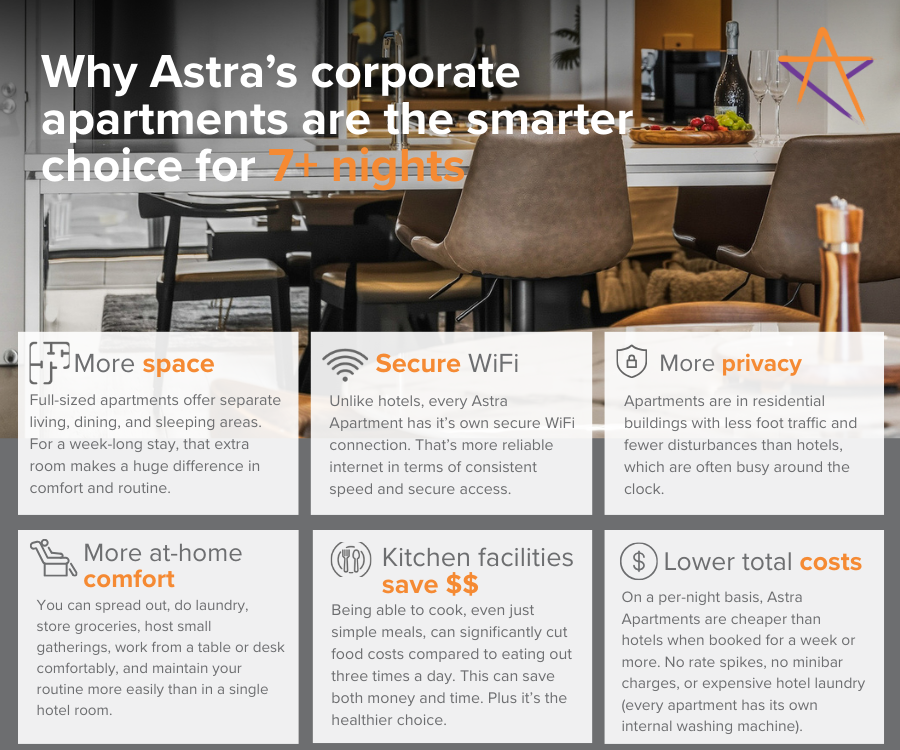
Aligning With the Three Stakeholders That Matter
- Procurement wants predictability
- Finance wants total cost savings
- Travel managers want happy, productive travellers
Corporate apartments – especially for 30+ night stays – tick every box.
When Astra Apartments Becomes the Most Economical & Practical Choice
Scenarios Where Corporate Apartments Win Every Time
- Multi-week corporate relocation
- Project teams with shifting timelines
- Medical, training, or secondment stays
- Assignments requiring high productivity
Conclusion: Empowered Buyers Make Better Decisions
As corporate travel continues to evolve, the organisations that understand long-stay accommodation dynamics are the ones achieving:
- Better budget outcomes
- Higher traveller satisfaction
- Lower churn on difficult assignments
- More predictable financial planning
For more information on extended stay accommodation in Australia, check out this post.
Hotels absolutely have their place
Hotels absolutely have their place, but for long stays, the economics, comfort, and traveller experience of corporate apartments make them the smarter choice.
When accommodation is chosen well, everyone wins – finance, procurement, travel teams, and most importantly, the traveller.
FAQs
They eliminate major daily expenses like meals and laundry while offering stable, predictable rates.
They can do so, but they often exclude blackout periods, which can result in significant unplanned cost spikes.
More space means better sleep, better productivity, and a more balanced routine – critical over 30+ nights.
Absolutely. Rates can be tailored based on volume or stay patterns and remain consistent year-round.
Meals, laundry, Wi-Fi upgrades, workspace rentals, parking, and peak-season surcharges.
Yes. Stable rates and flexible availability make extensions smooth and cost-predictable.
They adhere to strict safety standards and provide private, secure environments ideal for extended stays. See this article for more info.
