
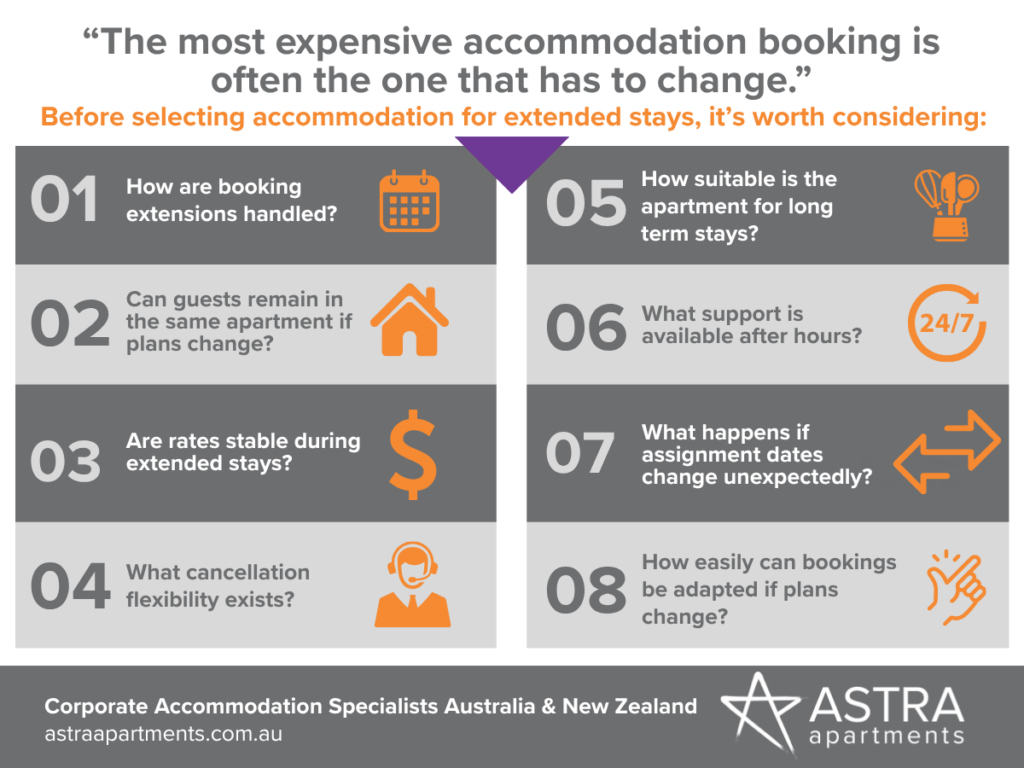
The most expensive accommodation booking is often the one that has to change.
In corporate travel and employee mobility, extended stay corporate accommodation is often booked based on one key metric: nightly rate.
But for longer-term business travel, projects and relocations, the nightly rate is rarely the full story.
Because plans change. Then the hidden costs emerge.
Project timelines shift unexpectedly. Relocations are delayed. Business priorities evolve mid-assignment. Employees arrive before permanent housing is ready. Teams extend projects by another month. Visa approvals move slower than expected.
And when accommodation arrangements aren’t designed to handle change, the operational, financial and traveller impacts can escalate quickly. For travel managers, mobility teams, relocation specialists and TMCs, flexibility is increasingly becoming just as important as cost.
Most Extended-Stay Travel Plans Change
Short business trips are relatively predictable.
Extended stays are not.
We see it every day. Longer-term travel and relocation programs involve moving timelines, evolving project scopes and multiple stakeholders. And increasingly, external pressures – from economic uncertainty to geopolitical events are creating even more unpredictability
That’s not poor planning – it’s simply the reality of extended business travel.
The problem is that accommodation is often booked as though dates are fixed from the outset. And that’s where costs start compounding. Not only because the nightly rate can change dramatically, but also, every adjustment creates operational friction:
- cancellation exposure
- extension pricing
- guest relocations
- rebooking administration
- approval delays
- traveller disruption
These are the costs many programs fail to account for upfront.
Travel Bookers Should Be Asking These Questions:
Cancellation Terms Are Important
A mistake organisations make when sourcing accommodation is focusing heavily on the nightly rate while paying little attention to cancellation flexibility.
That works fine – until plans change.
And as we’ve already surfaced, in long-stay travel and relocation, plans change often.
We regularly see situations where:
- projects are halted right before commencement
- assignees secure permanent housing earlier than expected
- interstate or international transfers are postponed
In these situations, rigid and unreasonable cancellation terms can create significant unexpected cost exposure. Particularly in apartment accommodation, cancellation policies can vary substantially between providers. Some offer reasonable flexibility. Others require lengthy notice periods or impose substantial penalties once a booking is confirmed.
The difference can have a noticeable impact on overall program cost.
Extensions sound simple. Operationally, they can be a major headache
One of the most common scenarios in extended-stay accommodation is the need to extend a booking.
On paper, adding another week or two seems straightforward. But operationally, extensions can become surprisingly complex.
If availability is limited, travellers may no longer be able to remain in the same apartment. If demand has increased due to holiday periods or popular events, rates may change significantly. Internal approvals may need to be revisited. Travel teams may need to source alternative accommodation at short notice.
What initially looks like a minor date adjustment can quickly become:
- a forced apartment move
- additional administration
- higher accommodation costs
- traveller dissatisfaction
- lost productivity
For the guest, it can feel deeply disruptive.
Think of it like this; by the second or third week of an extended stay, people stop treating accommodation like a hotel room. It becomes their living environment. They establish routines, settle in and learn the neighbourhood. They begin operating as though they temporarily live there.
Having to unexpectedly relocate midway through an assignment is rarely viewed as a small inconvenience by the traveller experiencing it.
The Hidden Cost Nobody Measures: Moving the Guest

One of the least discussed costs in extended business accommodation is the impact of moving travellers between properties.
Which is surprising, given how often it happens.
Sometimes the move is caused by lack of extension availability as we mentioned above. Other times it’s because the original accommodation wasn’t well suited to longer-term living in the first place.
Either way, the operational cost goes far beyond transport expenses or additional cleaning fees. There are harder-to-measure impacts that can be equally important:
- disruption to routine
- lost productivity
- traveller fatigue
- increased stress
- inconsistency in experience
- frustration for senior or business-critical travellers
For relocating employees or long-stay assignees, accommodation plays a much bigger role than simply providing somewhere to sleep. It becomes part of how they live and work during the assignment.
This is why accommodation stability is becoming more important in conversations around employee experience, mobility success and talent retention.
Relocation Timelines Rarely Go Exactly To Plan
For relocation providers and mobility teams, uncertainty is often built into the process. Permanent housing may take longer to secure than anticipated. Settlement dates shift. School placements change timelines. Family arrivals get delayed. Visa approvals take longer than expected.
Temporary accommodation therefore becomes more than a stopgap solution. It becomes the stabilising layer between uncertainty and disruption.
When accommodation providers operate with rigid cancellation policies, inconsistent inventory or limited extension flexibility, the pressure placed on mobility teams increases significantly. At that point, the challenge is no longer simply sourcing accommodation. It becomes managing instability.
The Cheapest Option Can Become The Most Expensive Operationally
This is where the conversation around accommodation procurement is starting to change. Traditionally, accommodation programs have focused heavily on nightly rate, preferred pricing, and inclusions. But for extended stays, the operational impacts of inflexible accommodation can outweigh the initial savings very quickly.
A lower nightly rate means little if:
- travellers need to relocate mid-stay
- cancellations trigger penalties
- extensions create pricing blowouts
- teams spend hours managing changes
- the traveller experience deteriorates
Increasingly, travel and mobility teams are evaluating accommodation providers based on their ability to adapt when plans inevitably shift.
That includes:
- cancellation flexibility
- extension capability
- inventory consistency
- responsiveness
- operational support
- long-stay suitability
Because in extended business travel, flexibility is no longer simply a convenience. It’s part of risk management.
Not All Apartment Accommodation Operates The Same Way
Another challenge for buyers is that “apartment accommodation” can mean very different things operationally. Hotel-style serviced apartments, short-term furnished rentals and dedicated corporate accommodation providers often operate under very different models – particularly when plans change. Some are built primarily for short transient stays. Others are designed specifically around long-stay corporate and relocation requirements.
That distinction becomes far more important once flexibility, continuity and traveller stability enter the equation. The accommodation itself may look similar online. The operational experience often is not.
Looking Beyond The Nightly Rate
In today’s environment, change is normal. For organisations managing extended business stays, accommodation flexibility is no longer simply a “nice to have”. It has become an operational consideration that directly affects cost, traveller experience and program efficiency.
Because when plans change – and they almost always do – the true value of accommodation is often determined by how well it adapts alongside them.
As a dedicated extended stay corporate accommodation provider for 25 years, Astra Apartments has seen it all. We therefore know the pain points that arise for bookers and companies when plans change. As such, our business model has been tailored to ensure companies have an accommodation partner that is easy to work with when this happens.
