

Rate spike shock… it’s real.
Imagine you’ve arranged accommodation in Melbourne for an employee on an eight-week project. You’ve found a well-located hotel offering an attractive nightly rate, the booking fits the travel budget, and everything looks straightforward.
Then you notice the assignment overlaps with the Australian Grand Prix.
Suddenly, the nightly rate spikes, which isn’t quite so attractive.
It’s a familiar challenge for anyone responsible for booking corporate accommodation. Hotels quite reasonably want to maximise revenue when demand is high. Whether it’s a major sporting event, an international conference or a stadium concert, there’s a commercial incentive to charge more when rooms are in short supply. So dynamic pricing is used.
But corporate travel bookers have a different priority. They’re trying to secure suitable accommodation, manage costs and give their clients or colleagues certainty about what an assignment will cost.
Two perfectly rational objectives. One potential pricing problem.
For short business trips, dynamic pricing is often simply part of the accommodation landscape. But when an employee needs somewhere to live for several weeks or months, does the same pricing model make sense?
Dynamic pricing: Good for revenue, but what about corporate budgets?
Dynamic pricing is a widely used revenue management strategy in the hotel industry. Rather than maintaining one consistent rate, accommodation providers adjust prices in response to factors such as demand, availability, seasonality and major events.
It’s an effective way to manage revenue, and it isn’t necessarily a disadvantage for corporate travellers. That’s because businesses booking during quieter periods may benefit from lower rates.
The challenge arises when a corporate stay extends across several different demand periods.
A three-night business trip might fall entirely within a relatively stable pricing window. An eight-week assignment is far more likely to overlap with weekends, conferences, school holidays or major events.
For travel management companies, procurement teams, relocation specialists and corporate travel bookers, that can make accommodation costs harder to predict. And when the priority is managing an extended assignment within an agreed budget, predictability matters.
The starting rate doesn’t always tell the whole story
When comparing accommodation, the nightly rate is often the first figure looked at. It’s easy to understand, simple to compare and useful for narrowing down options.
But for long-stay corporate accommodation, it can also be misleading if it doesn’t represent the cost of the entire booking.
Let’s circle back to the employee travelling to Melbourne for eight weeks.
One hotel advertises a rate of $220 per night. A corporate apartment is available for $250 per night. At first glance, the hotel appears to be the more economical choice. Over 56 nights, that $30 difference looks significant.
But what happens if the hotel rate increases during a major event?
A tale of two rates: The eight-week stay in Melbourne
Let’s compare two hypothetical accommodation options for the same 56-night assignment.
Option A: A dynamically priced hotel
The nightly rate starts at $220, increases to $420 during a two-week high-demand period, then settles at $260 for the remaining three weeks.
Option B: A fixed-rate corporate apartment
The nightly rate remains at $250 throughout the eight-week stay, including the high-demand period.
| Period | Dynamic Hotel Rate | Fixed Apartment Rate |
|---|---|---|
| Weeks 1 – 3 (21 nights) | $220 | $250 |
| Weeks 4 – 5 (14 nights) | $420 | $250 |
| Weeks 8 – 8 (21 nights) | $260 | $250 |
| Total accommodation cost | $15,960 | $14,000 |
| Average nightly rate | $285 | $250 |
These are hypothetical rates, not actual hotel or Astra Apartments quotes. The comparison assumes rates are known at the time of booking and excludes differences in inclusions, taxes and booking conditions.
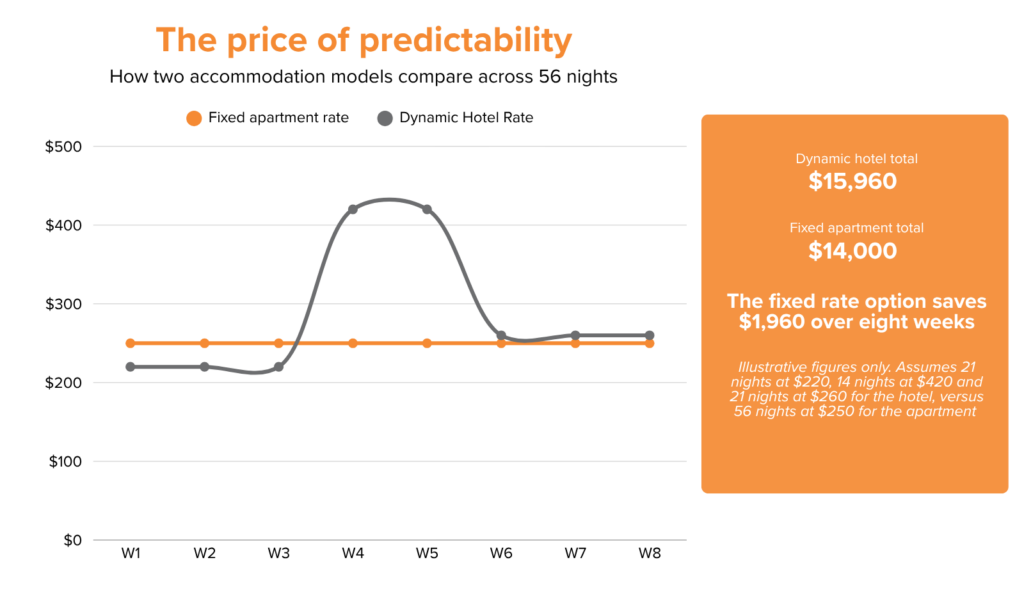
The result?
Despite starting at a lower nightly rate, the hotel costs $1,960 more over the eight-week assignment. That’s approximately 14% more than the fixed-rate apartment.
The point isn’t that dynamically priced hotels will always be more expensive. In some circumstances, they may offer the better deal. It’s that the starting rate doesn’t necessarily reflect the total cost of a long stay.
For corporate travel buyers, the more useful question is: What will this accommodation actually cost for the full duration of the assignment?
And just as importantly, how confident can we be in that figure?
When eight weeks becomes ten: The cost of an unexpected extension
Anyone who manages corporate travel knows that assignments don’t always go according to plan. A project runs behind schedule. A new employee’s permanent accommodation isn’t ready. A relocation takes longer than expected. A specialist is needed on-site for another fortnight.
What was originally an eight-week stay becomes ten.
From an accommodation perspective, those additional two weeks can introduce a new set of challenges.
It’s important to distinguish between an existing confirmed booking and an extension. A hotel using dynamic pricing doesn’t necessarily change the rate of nights already booked and confirmed. However, additional nights may be treated as a new booking, subject to the rates and availability at the time of the extension. And ff those extra nights happen to coincide with a major event, the cost could be considerably higher than anticipated.
For example, imagine our Melbourne assignment needs to be extended by 14 nights.
If the hotel offers those additional nights at $420, the extension costs $5,880.
At a continued fixed rate of $250, the equivalent extension costs $3,500.
That’s a potential difference of $2,380 for just two weeks.
Should rate volatility be a corporate travel procurement consideration?
Corporate accommodation procurement has traditionally focused on measures such as average nightly rate, location, policy compliance, traveller satisfaction and overall value. All which remain important. But for extended stays, there’s a case for adding another consideration: rate volatility. Rate volatility refers to how much accommodation prices fluctuate across a particular period. Rather than evaluating price alone, corporate travel buyers could consider five measures:
- Total stay cost
What is the complete accommodation cost for the proposed assignment, including any higher-priced dates? This provides a more meaningful comparison than the advertised starting rate. - Peak nightly rate
How high does the rate climb during the stay? Understanding the highest rate helps identify exposure to major events and seasonal demand. - Rate variation
How much does the nightly rate fluctuate across the booking period? A relatively stable rate may make accommodation expenditure easier to forecast and explain. - Extension terms
If the assignment continues beyond the original departure date, will the same rate apply? Is an extension subject to availability or repricing? - Total cost and inclusions
What is included in the accommodation rate? WiFi, utilities, cleaning, laundry facilities and other services can affect the overall cost of a long stay.
Together, these measures provide a more complete picture of accommodation value. They also help travel bookers compare options on a like-for-like basis, rather than relying on a single nightly rate.
Instead of simply asking, “What’s your best nightly rate?”, it may be worth asking:
“What is the total cost of this assignment, how much could that cost change, and what happens if our employee needs to stay longer?”
For long-stay corporate travel, those answers may be just as important as the initial quote.
The hidden value of budget certainty
Predictable accommodation pricing offers benefits that extend beyond the final invoice. For a corporate travel manager, it can mean fewer unexpected budget variations and a clearer view of travel expenditure. For a procurement team, it makes supplier comparisons and financial forecasting more straightforward. For a travel management company, it can help deliver more consistent recommendations and manage client expectations. In each case, there’s value in reducing uncertainty.
Consider the administrative work involved when accommodation costs exceed an approved budget. There may be additional approvals to obtain, revised purchase orders to arrange or explanations to provide to finance teams.
A predictable rate doesn’t eliminate every challenge associated with corporate travel, but it can remove one significant variable.
Does this mean dynamic pricing is wrong for corporate travel?
Not at all.
Dynamic pricing serves a legitimate commercial purpose, and there are situations where it works well for corporate buyers.
For short stays, flexible travel dates or trips scheduled during quieter periods, dynamically priced accommodation may offer excellent value. The key is understanding when the pricing model suits the nature of the booking. An overnight business trip and a three-month project assignment have very different accommodation requirements. For shorter trips, securing the best available rate may be the primary consideration. For extended stays, factors such as price stability, flexibility, comfort and continuity become increasingly important.
It’s not a question of dynamic versus fixed pricing. It’s about matching the accommodation solution to the way the business travels.
The bottom line: predictability deserves a place at the table
For long-stay corporate travel, the best accommodation rate isn’t necessarily the lowest rate you can find today. It’s the rate that makes sense for the entire assignment.
At Astra Apartments, we understand that managing corporate accommodation involves more than finding the right location at the right price. It’s about providing certainty, flexibility and a comfortable place for employees to call home while they’re away for work.
Discover how our corporate accommodation solutions can help you simplify extended-stay bookings and manage accommodation costs with greater confidence.
Talk to the Astra Apartments team about your next long-stay requirement.
