

Rate spike shock… it’s real.
For companies with established travel programs, negotiating corporate accommodation rates is standard practice. And for good reason. Agreed rates make budgeting easier, help control travel expenditure and give bookers a degree of certainty when arranging accommodation for employees.
But there’s a catch.
That carefully negotiated rate may not be available when you need it most.
A major sporting event rolls into town. An international conference fills the city’s hotels. Or a concert brings thousands of visitors into the CBD.
Suddenly, the corporate rate you’ve worked hard to secure is subject to a blackout period, and you’re back to searching for accommodation at whatever rates are available.
For an overnight business trip, that can be frustrating. For an employee who needs accommodation for eight weeks, it can become a much bigger problem.
Because the real value of a negotiated corporate rate isn’t just the price. It’s knowing you can actually access it when you need it.
A tale of two rates: The eight-week stay in Melbourne
Let’s compare two hypothetical accommodation options for the same 56-night assignment.
Option A: A hotel with blackout periods
The negotiated nightly rate is $250, but increases to $700 for four nights during a high-demand blackout period, before returning to $250 for the remainder of the assignment.
Option B: A corporate apartment with no blackout periods
The nightly rate remains at $260 throughout the eight-week stay, including the high-demand period.
| Period | Negotiated corporate rate – with blackout periods | Negotiated corporate rate. NO blackout periods |
|---|---|---|
| First 21 nights | $250 | $260 |
| 4 Nights blackout period | $700 | $260 |
| Remaining 31 nights | $250 | $260 |
| Total accommodation cost | $15,800 | $14,560 |
| Average nightly rate | $282 | $260 |
These are hypothetical rates, not actual hotel or Astra Apartments quotes. The comparison assumes rates are known at the time of booking and excludes differences in inclusions, taxes and booking conditions.
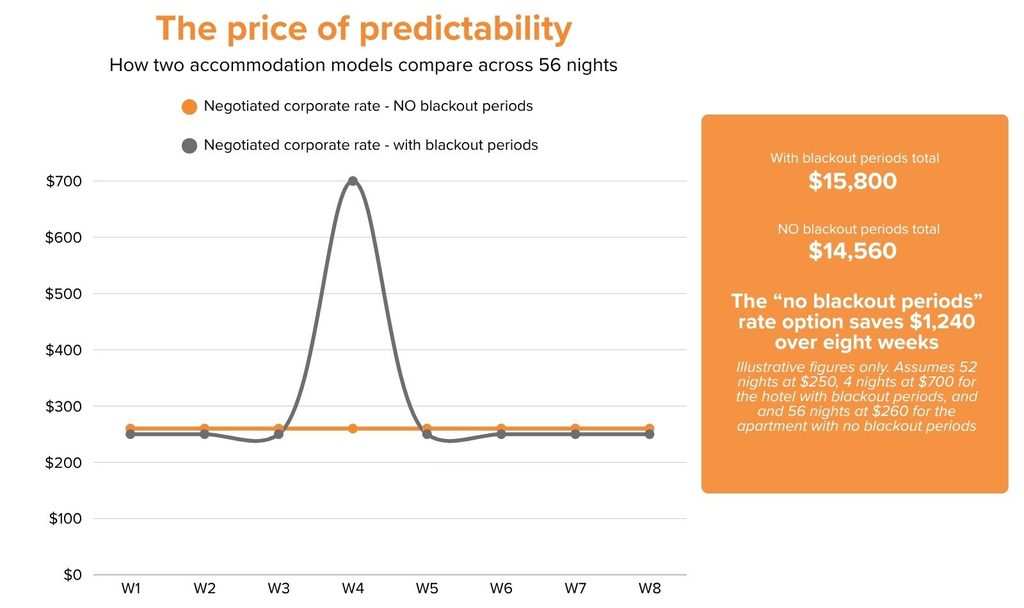
The result?
Despite starting at a lower nightly rate, the hotel costs $1,240 more over the eight-week assignment. That’s approximately 8.5% more than the fixed-rate apartment. And all because of four nights affected by blackout pricing.
And while higher accommodation costs are frustrating, they’re not necessarily the biggest headache. Sometimes, the problem isn’t what you’ll pay during a blackout period. It’s whether the employee can stay in the same accommodation at all.
When a blackout period means moving out
Depending on the hotel’s booking conditions and availability, it may not be possible to secure the entire assignment at the negotiated rate. If part of the stay falls within a blackout period, the booker may face a difficult choice: pay a significantly higher rate, find alternative accommodation for those nights, or arrange for the employee to move elsewhere.
For the person managing the booking, that creates a whole new set of challenges.
There’s alternative accommodation to source, often at short notice and during a period when availability is already tight. There may be additional transport costs, new booking arrangements and more administration. And if the employee is expected to return to the original property afterwards, the whole process happens twice.
But perhaps the biggest impact is on the employee. Imagine being six weeks into a three-month assignment, comfortably settled into your accommodation, but having to move for a few nights because the original booking couldn’t be secured across a major event. For someone working long hours away from home, it’s an unwelcome disruption. They’ve established a routine, know their neighbourhood and have made the accommodation their temporary home. Moving out, even briefly, can affect their comfort, productivity and overall experience.
And for companies with duty of care responsibilities, ensuring employees have suitable, safe accommodation throughout their assignment is an important consideration.
The true cost of a blackout period isn’t always reflected in the accommodation invoice. There’s also the time spent making alternative arrangements, the potential additional expenses and the disruption to the person staying.
For extended corporate assignments, continuity matters. Knowing an employee can remain comfortably settled in one place for the duration of their stay can be just as valuable as knowing what that stay will cost.
What should corporate buyers look for beyond the negotiated rate?
The practical questions become:
- Are there blackout dates, and when do they apply?
- Is the negotiated rate guaranteed, or subject to availability?
- Can a long-stay booking span a blackout period at the agreed rate?
- What happens if the employee needs to extend their stay?
- What is the total cost of the assignment, including any nights when the corporate rate doesn’t apply?
Together, these measures provide a more complete picture of accommodation value. They also help travel bookers compare options on a like-for-like basis, rather than relying on a single nightly rate.
For long-stay corporate travel, those answers may be just as important as the initial quote.
Negotiated corporate rates are common. Negotiated rates without blackout dates are what make the difference.
At Astra Apartments, we understand the importance of predictable accommodation costs, particularly for extended corporate stays. That’s why our approach is built around consistent, competitive pricing without seasonal rate spikes or blackout dates.
For companies, travel management partners and relocation specialists, it means greater confidence when planning assignments that cross major events or high-demand periods.
And when plans change, our flexible booking arrangements and responsive local teams help make extensions and date changes easier to manage, subject to availability.
Because for long-stay corporate travel, it’s not just about negotiating a good rate. It’s about having confidence in that rate when you need it.
Talk to the Astra Apartments team about your next long-stay requirement.
